
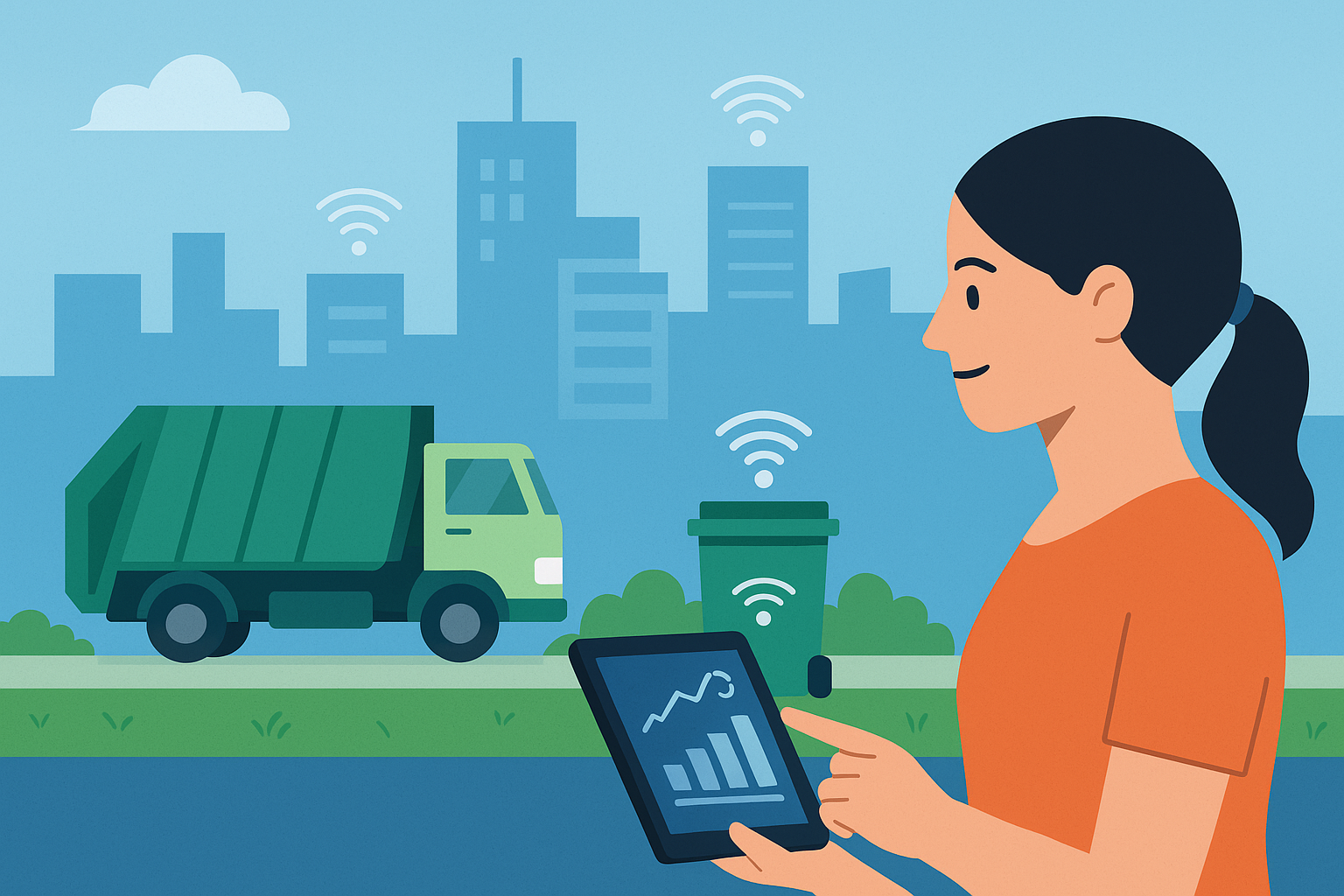
How Smart Waste Management Solutions Are Transforming Cities
Picture this: a city commissioner walks through their district and sees overflowing bins, garbage trucks stuck in traffic burning fuel on inefficient routes, and mounting pressure from citizens demanding better services. Meanwhile, compliance officers are scrambling to meet ESG and EPR requirements with nothing but paper logs and guesswork.
This isn’t a dystopian future scenario. It’s happening right now in cities worldwide. Smart waste management has evolved from being a nice innovation to an absolute necessity for urban survival.
The Numbers Don’t Lie: We Have a Global Waste Crisis
Municipal solid waste remains one of the least digitized sectors in urban governance, and the consequences are staggering. The World Bank’s comprehensive “What a Waste 2.0” report paints a sobering picture: global waste generation will surge by 70% by 2050 if we continue with business as usual.
Consider these eye-opening statistics: nearly 27% of the global population still lacks access to proper waste collection services. Even more alarming, up to 33% of all waste is openly dumped or burned, often leaving no digital footprint whatsoever.
For city leaders, these aren’t just abstract numbers on a report. They translate into real, tangible challenges: untracked zones with overflowing bins, inefficient fleet operations that waste precious fuel resources, and increasing pressure to meet stringent ESG and EPR compliance frameworks.
The Hidden Problem: Technology Without Integration
Here’s where most cities get it wrong. The challenge isn’t the absence of technology. It’s the absence of meaningful operational integration.
Many well-intentioned smart city initiatives have deployed GPS trackers and dashboard tools in isolation, expecting them to magically transform municipal services overnight. But here’s the harsh truth: visibility without accountability is simply a more expensive spreadsheet.
Private technology vendors often compound this problem by selling isolated systems that fail to integrate with local governance workflows or national compliance mandates. The reality is that effective municipal waste tracking must seamlessly connect EPR compliance, ESG metrics, and citizen service delivery in real time.
Yet despite all the technological advances available today, most cities continue operating their sanitation infrastructure as if it were still 2005, relying on paper logs, unverifiable pickup records, and zero intelligence around waste diversion rates.
The EcoSense Philosophy: Treating Waste as a Data Challenge
At EcoSense, we’ve fundamentally reimagined the approach to waste management. We believe that waste is primarily a data problem that requires a data-driven solution.
Our methodology begins with establishing comprehensive end-to-end traceability across the entire waste value chain, from initial collection bins to final processing facilities. We achieve this through a sophisticated combination of IoT sensors, AI-powered classification systems, and QR-verified service logs.
What distinguishes EcoSense from generic tracking solutions or fragmented applications is our platform’s native ability to integrate seamlessly with municipal Integrated Command and Control Centers, public transparency dashboards, and sustainability disclosure systems.
Our key technological differentiators include AI-driven bin recognition capabilities that can identify overflow conditions or contamination issues using standard camera feeds, eliminating the need for expensive capital expenditure on specialized sensors. We provide EPR-ready traceability that captures detailed waste volume data, category classifications, and brand identifiers at Material Recovery Facilities to streamline compliance processes. Our open API architecture enables smooth integration with ICCC systems, ERP platforms, and real-time citizen grievance portals.
Most importantly, our systems don’t merely digitize existing processes. They create a closed loop between operational execution, policy implementation, and measurable impact.
Real-World Success: The Ranchi Smart City Transformation
The transformation of Ranchi Smart City perfectly illustrates the power of integrated smart waste management. The municipality faced a classic challenge: manual tracking systems that produced unreliable service logs, frequent missed pickups, and eroding trust from residents.
The scope of the problem was daunting. Across 53 wards, the municipality had virtually no real-time visibility into operations, with over 200 waste collection vehicles managed through pen-and-paper logs and verbal status updates.
EcoSense implemented a comprehensive solution that included QR-tagging deployment across more than 216,000 households, GPS and RFID-based pickup validation systems, and real-time operational dashboards at both zonal and city headquarters levels.
The results were remarkable and measurable. Within just 90 days, the city achieved 98% service coverage compliance. Route optimization delivered a 30% efficiency gain, significantly reducing fuel consumption and operational costs. Perhaps most importantly, the city gained complete transparency into daily waste types, volumes, and diversion rates.
EcoSense successfully transformed a sprawling, manual network into a measurable, optimized system that serves as a model for other cities.
The Broader Impact: Why Every City Should Care
Every city pursuing SDG 11 (Sustainable Cities and Communities) or SDG 12 (Responsible Consumption and Production) must embed digital circularity principles into their waste management systems.
The environmental stakes couldn’t be higher. Methane emissions from landfills represent a significant contributor to climate change, with waste accounting for over 20% of human-driven methane emissions according to IPCC research. Digitized tracking systems enable cities to reduce landfill dependency, boost recycling rates, and report emissions accurately under Scope 3 requirements.
The financial implications are equally compelling. Climate finance mechanisms, green bonds, and smart city grants increasingly require data-backed proof of operational efficiency and environmental impact. Without comprehensive traceability systems, cities simply aren’t eligible for these crucial funding opportunities.
Your Path Forward: From Waste Management to Waste Intelligence
EcoSense doesn’t just help cities clean up more efficiently. We help them develop the intelligence to make smarter decisions about their waste streams.
Whether you’re managing a dense metropolitan ward or implementing compliance tools across an entire smart city initiative, we offer customized pathways to achieve your ESG, EPR, and circularity objectives.
For Urban Local Bodies, we provide comprehensive smart waste audits that benchmark current performance and identify immediate opportunities for gains in compliance, operational efficiency, and cost reduction.
For Corporates and ESG Consultants, we offer zero-waste assessments through our customizable dashboard platform. You can map waste streams, align with SDG metrics, and simplify Scope 3 reporting processes.
For Systems Integrators, we provide ICCC-ready API integrations that enhance your portfolio with seamless smart waste management modules.
The Future of Urban Waste Management
Smart waste management isn’t really about bins and trucks. It’s about the intelligence systems that govern them, optimize them, and learn from them.
The cities that will thrive in the coming decades won’t just manage their waste more efficiently. They’ll transform waste streams into valuable data insights that drive better policy decisions, improve citizen services, and contribute to global sustainability goals.
Let’s work together to build cities that don’t just manage waste, but learn from it and use those insights to create more sustainable, efficient, and livable urban environments for everyone.