
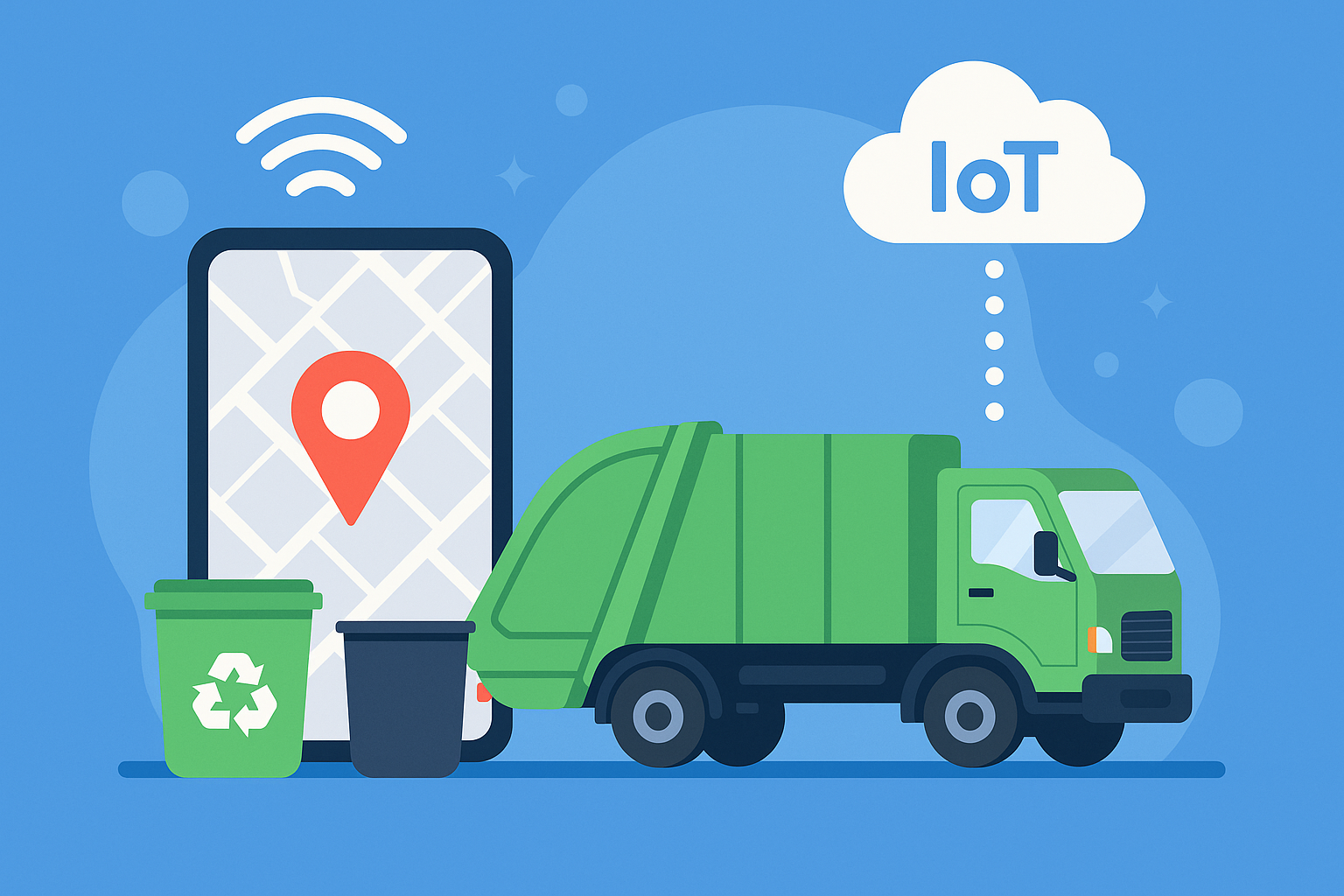
Harnessing IoT for Real-Time Waste Tracking: The Future of Urban Waste Management
Across the globe, municipalities, corporations, and systems integrators find themselves under mounting pressure to modernize their waste operations while meeting increasingly stringent ESG reporting requirements. The transformation we’re witnessing today goes far beyond simple digitization. IoT-enabled real-time tracking is fundamentally reshaping solid waste management, evolving it from a fragmented logistical challenge into a sophisticated, data-rich sustainability engine.
This comprehensive analysis explores why GPS, RFID, and smart sensors have become essential infrastructure for Urban Local Bodies, examines how real-time tracking capabilities drive regulatory compliance, and demonstrates how EcoSense is establishing new industry benchmarks for integrated waste intelligence.
The Current Reality: A System Built on Blind Spots
The stark reality facing waste management systems across developing and emerging markets is their continued reliance on analog processes. The World Bank’s comprehensive “What a Waste 2.0” report reveals a troubling statistic: more than 33 percent of global waste continues to be mismanaged through open dumping or uncontrolled burning practices.
This fundamental lack of visibility creates cascading problems throughout the waste management ecosystem. Municipalities operate without clear insight into collection patterns, transportation efficiency, or the ultimate destination of waste streams. The critical question of what materials end up in landfills versus being successfully diverted for recycling remains largely unanswered.
For ULB commissioners and Smart City implementation teams, these data gaps translate into underreported service levels, missed segregation targets, growing public dissatisfaction, and significant regulatory blind spots. ESG officers face an equally challenging scenario, struggling with incomplete Scope 3 disclosures and sustainability reports that lack the granular data necessary for meaningful impact assessment.
The common thread connecting these challenges is the absence of reliable, comprehensive data. Without accurate information about waste flows, decision-makers across all levels find themselves operating in the dark, making critical choices based on assumptions rather than evidence.
The Industry’s Fundamental Misunderstanding
A pervasive misconception exists within the waste management industry regarding what constitutes effective digitization. Many operators believe that adding GPS tracking to collection vehicles or implementing citizen grievance applications represents adequate modernization. However, this approach fundamentally misunderstands the complexity of comprehensive waste tracking.
The critical oversight lies in the scope of tracking requirements. Effective waste management demands tracing waste movement from its initial source through to final processing, complete with detailed timestamps, accurate weight measurements, and precise geospatial markers. Without this comprehensive approach, it becomes impossible to verify service provision, enable Extended Producer Responsibility compliance, or optimize collection routes effectively.
The current marketplace compounds this problem through fragmentation. Organizations typically encounter a bewildering array of siloed solutions: one vendor specializing in RFID technology, another focused on dashboard development, and a third handling workforce management systems. This fragmented approach inevitably results in disjointed systems, incomplete data sets, and a complete absence of accountability across the waste management chain.
The EcoSense Philosophy: Systems Thinking for Waste Intelligence
At EcoSense, we’ve developed a fundamentally different perspective on waste tracking challenges. We recognize that waste tracking isn’t primarily a hardware problem requiring more sensors or devices. Instead, it’s a complex systems problem that demands sophisticated orchestration and integration.
Our approach centers on an IoT-enabled waste intelligence stack that seamlessly combines GPS tracking, RFID technology, QR codes, and BLE sensors into a unified, real-time data layer. This comprehensive system tracks every critical touchpoint throughout the waste management process: from bins that are geo-tagged to specific households, through pickup timestamps and vehicle diagnostics, all the way to final tipping at Material Recovery Facilities.
The architecture we’ve developed features an open API design that enables seamless integration with Integrated Command and Control Centres, while our sophisticated AI layer ensures that bin-level data isn’t merely collected but actively interpreted. Our system proactively identifies overflows, detects contamination issues, and flags route anomalies before they become operational problems.
Three key differentiators set EcoSense apart in the marketplace. First, we provide EPR-ready data granularity that enables organizations to trace recyclables back to their source, validate material types, and flag brand-level packaging data for compliance purposes. Second, our real-time service validation capabilities use QR code scanning and geo-fencing technology to definitively confirm whether a location was serviced and precisely when that service occurred. Third, our open and modular architecture allows clients to implement solutions in phases, beginning with collection optimization, then expanding to processing integration, and finally incorporating comprehensive ESG reporting, all using the same core technological foundation.
Real-World Impact: The Ranchi Municipal Corporation Success Story
The transformation achieved by Ranchi Municipal Corporation provides a compelling illustration of IoT-enabled waste tracking potential. The municipality faced challenges that will be familiar to many urban administrators: manual collection logs, paper-based route sheets, and complete absence of service-level visibility across 53 wards.
The operational breakdown was comprehensive and frustrating. Citizens regularly complained about missed pickups, while commissioners lacked access to meaningful KPI dashboards. Although RFID tags had been installed throughout the system, they remained significantly underutilized, providing little value to operational decision-making.
EcoSense implemented a comprehensive solution that included QR and RFID tagging across more than 216,000 households, GPS-enabled fleet tracking with bin-level service confirmation, and a centralized dashboard providing real-time visibility into daily pickup compliance, zone-wise service gaps, and detailed waste volume analytics.
The results achieved were both immediate and substantial. Route adherence improved dramatically from sub-70% to over 95%. The municipality achieved 100% verifiable pickup confirmation, eliminating disputes about service provision. Optimized routing delivered 18% fuel savings, significantly reducing operational costs while improving environmental performance. Perhaps most importantly, the dashboard integration with the ICCC provided complete service visibility across all six municipal zones, enabling proactive management and rapid response to emerging issues.
The Broader Implications: Why Real-Time Tracking Matters
Real-time waste tracking has evolved from being a desirable enhancement to becoming foundational infrastructure for modern governance and ESG leadership. The implications extend far beyond operational efficiency improvements.
For municipal governments, comprehensive tracking systems unlock improved Swachh Survekshan performance metrics, dramatically reduce citizen complaints, and enable the implementation of data-driven contracts with service providers. The ability to demonstrate measurable service improvements becomes a powerful tool for public accountability and citizen satisfaction.
Corporate organizations benefit through enhanced Scope 3 waste disclosures and the ability to achieve ambitious zero-waste-to-landfill goals. As ESG reporting requirements become increasingly stringent, the granular data provided by IoT tracking systems becomes essential for credible sustainability reporting.
Systems integrators gain the ability to offer seamless ICCC and city-application integrations, eliminating the operational bottlenecks created by siloed hardware providers. This integration capability becomes a significant competitive advantage in smart city implementations.
From a climate perspective, real-time tracking contributes to meaningful methane emission reductions by minimizing delays in wet waste collection and supporting optimized routing to composting or biogas facilities. These improvements directly support progress toward SDG 11 (Sustainable Cities) and SDG 13 (Climate Action).
The environmental impact potential is substantial. According to UNEP research, improving waste management systems could reduce global methane emissions by 20%, with the primary mechanism being the digitization of organic waste flows. This statistic underscores the critical role that comprehensive tracking systems play in global climate action efforts.
Implementation Pathways: Choosing Your Next Steps
The path forward depends on your organizational role and specific objectives. For ULB commissioners and Smart City CEOs, the logical first step involves conducting a comprehensive smart waste audit to establish baseline performance metrics and identify immediate improvement opportunities.
Corporate ESG leaders should consider implementing zero-waste assessments using specialized ESG dashboard tools that can map waste streams, align with SDG metrics, and simplify Scope 3 reporting processes.
Systems integrators and ICCC vendors can explore API and device integration capabilities that enhance their existing portfolios with seamless smart waste management modules.
Conclusion
The transformation of waste management through IoT-enabled real-time tracking represents more than technological advancement. It represents a fundamental shift toward data-driven decision-making, environmental accountability, and operational excellence.
As we face mounting environmental challenges and increasingly complex regulatory requirements, the organizations that will thrive are those that embrace comprehensive waste intelligence. The question isn’t whether to implement real-time tracking systems, but how quickly and effectively these systems can be deployed.
The future of waste management lies in making waste streams visible, measurable, and actionable. Because in the end, what gets tracked gets managed, and what gets managed gets improved. The time for half-measures and fragmented solutions has passed. The future demands integrated, intelligent systems that can meet the complex challenges of modern urban waste management.